Showing posts with label design. Show all posts

Thursday, February 6, 2014

Estudio de caso: Tapas de alcantarillas en Celaya

Estudio de caso: Tapas de alcantarillas en Celaya

Palabras y Fotos por Michele Perez

El Problema

La ciudad de Celaya, Gto. en México, con una población cercana a los 500,000 habitantes, sufría de un problema con sus tapas de alcantarillas y rejas de alcantarillado — se las estaban robando por el valor de su hierro. La ciudad necesitaba encontrar una solución creativa para reducir, o eliminar, el robo de estas piezas de hierro.


Durante el 2013 desaparecieron aproximadamente 100 tapas de alcantarillas y 647 rejas de alcantarillado. El costo para reponerlas, incluyendo materiales y mano de obra, esta entre los $1,300 y 1,700 MXN ($99-120 USD a tipos de cambio corrientes) por cada tapa de hierro y $430 MXN ($32 USD) por cada reja. En total, la ciudad gastó aproximadamente $428,210 MXN ($32,686 USD or 23,720 EUR) en reemplazarlas en el 2013. La ciudad probó reemplazar las tapas de hierro con tapas de concreto, pero esas se rompían muy facilmente. Para una ciudad en rápido crecimiento como Celaya, estos robos no eran solo una molestia sino un gasto significativo tanto para el ayuntamiento como sus ciudadanos contribuyentes, y era necesario encontrar una mejor solución.


La Solución

Ya que la cultura del reciclaje no está arraigada en los hogares Celayenses, la ciudad implementó un sistema de separación de materiales reciclables y reusables en el basurero municipal. Usando máquinas y obreros, se separan telas, vidrio, cartón, aluminio y plástico de las más de 300 toneladas de basura que se colectan diariamente en la ciudad. Después haber sido separados, los materiales son compactados y vendidos. Adicionalmente, el biogás que genera la basura en descomposición, es capturado y transformado en energía eléctrica. Ambas iniciativas son parte del programa nacional “Campo Limpio” el cual fomenta la reducción, el reciclaje y el reuso (upcycle) de la basura.


Los plásticos son después llevados a la Recicladora de Plásticos de Celaya para su reuso. Ahí, el polietileno es separado del resto de los plásticos y agrupado por color, para después pasar por un molino que lo reduce a unos pequeños cuadros de aproximadamente una pulgada de ancho; más adelante, una máquina los limpia y remueve todo tipo de etiquetas. Finalmente, los cuadros son empujadas por un segundo molino que los convierte en bolitas que parecen confeti negro o gris.


Estas bolitas son derretidas en moldes para crear productos nuevos como tablas de "madera" de varios tamaños para armar bancos, pequeñas unidades de almacenamiento e incluso baños portátiles. En realidad, estas bolitas pueden tomar cualquier forma según el diseño del molde,  así que, cuando el alcalde mencionó que la ciudad necesitaba reemplazar las tapas de alcantarillas, el arquitecto/diseñador de la planta le ofreció una solución en base a este proceso de reciclaje y reuso. Cada tapa de alcantarilla de plástico cuesta $800 MXN ($61 USD), un ahorro de $500 a 900 MXN ($38-69 USD) por pieza en comparación a su contraparte de hierro. Si hubiera necesidad de reemplazar las 19,000 tapas de alcantarillas en la ciudad, el ayuntamiento se ahorraría un mínimo de $9.5 millones MXN ($722,000 USD) al usar las nuevas tapas de plástico – una cantidad muy considerable.


Las tapas y rejas de plástico son el reemplazo ideal para el clima semi-desértico de Celaya y actualmente se han instalado en varias secciones de la ciudad donde se están haciendo mejoras municipales. A la fecha, ninguna de las tapas de plástico ha sido robada y la ciudad se ha ahorrado tanto costos financieros como del medio ambiente. Este es un claro ejemplo de como la basura de la ciudad ha sido reciclada y reutilizada para el beneficio de sus residentes.

*Todos los detalles fueron obtenidos por medio de entrevistas en persona y correspondencia con la oficina del Alcalde de la Ciudad de Celaya, Ismael Pérez Ordaz, y las oficinas de la Recicladora de Plásticos de Celaya.

Tapa de alcantarillas

Bolsas de plasticos

Bolitas de plastico

Friday, January 24, 2014

Case Study: Upcycled Manhole Covers / Estudio de caso: Tapas de alcantarillas upcycled

Case Study: Celaya’s Manhole Covers

Words and Photos By Michele Perez

The Problem

The city of Celaya in the Mexican state of Guanajuato, with a population of about 500,000, had a problem with their iron manhole covers and street grates -- they were being stolen and sold for the iron. The city wanted a creative way to reduce, or eliminate, thefts of these iron pieces.


During 2013, there were approximately 100 manhole covers and 647 street grates stolen. The cost to the city to replace each iron manhole cover is between $1,300-1,700 MXN pesos ($99-120 USD at current exchange rates), and the grates are about $430 MXN ($32 USD) including materials and labor. In total, the city spent approximately $428,210 MXN ($32,686 USD or 23,720 EUR) for iron replacements. The city tried replacing them with concrete manhole covers, but those broke too easily. For a quickly expanding city like Celaya, it was a nuisance and an unnecessary expense for the city and taxpayers, and a better solution was needed.

The Solution

Since there isn’t a culture of recycling at home in Mexico, the city already had in place a garbage collection system that included separation of reusable materials at the municipal dump. From the 300 tons of garbage collected daily, using machines and by hand, the workers separate out fabric, glass, cardboard, aluminum, and plastics. After separating materials by color, they are then compacted and the municipality sells the materials for revenue. Additionally, the city uses the biogas produced from the garbage in the dump for municipal energy purposes. This is all part of the “Campo Limpio” (Clean Fields) national program to reduce waste, and recycle and upcycle as much of the garbage as possible.


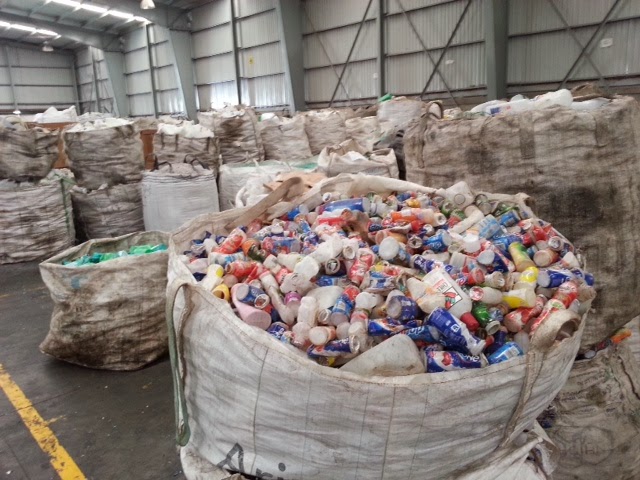
The plastics are taken to a sorting, recycling, and upcycling facility in a nearby industrial complex area, called Recicladora de Plásticos de Celaya, or “Plastics Recycler of Celaya”. Here they sort out the polythene plastics by color, then run the bottles and containers through a mill that reduces them into approximately one inch square pieces. Further, they are cleaned by a machine process and then labels and stickers are removed from the pieces in a third cleaning process. At this point they are pushed through another mill and turned into pellets that look like black or gray confetti.
These pellets are then used with molds to create upcycled materials like plastic “wood” planks of various widths and lengths for park benches, small storage units and even portable toilets. Truly, these pellets can be heated and formed into any shape, based on the the form of the mold. So when the mayor mentioned that the city needed to replace manhole covers the architect/designer at Recicladora de Plasticos came up with an affordable solution based on a plastic design. Each plastic manhole cover costs $800 MXN ($61 USD), a savings of $500-900 MXN ($38-69 USD) per new manhole cover. For a city with an estimated 19,000 manhole covers, if replacing all of them is required, there would be a minimum savings of $9.5million MXN ($722,000 USD) -- a sizable amount.


While the city is making municipal improvements to many sections of the city, the plastic manhole covers and grates are an ideal replacement in the semi-arid environment of Celaya. To date, none of the plastic versions have been stolen and it has saved the city in both financial and environmental costs. A clear example of how the city’s waste is upcycled into another use for the city’s residents.


*All details were from in-person interviews and correspondence with Mayor Ismael Perez Ordaz’s office of the City of Celaya and Recicladora de Plásticos de Celaya. 

Pellets / Bolitas

Sorted plastics / Plásticos clasificados

Finished manhole cover / Tapa de alcantarillas


Estudio de caso: Tapas de alcantarillas en Celaya


El Problema

La ciudad de Celaya, Gto. en México, con una población cercana a los 500,000 habitantes, sufría de un problema con sus tapas de alcantarillas y rejas de alcantarillado — se las estaban robando por el valor de su hierro. La ciudad necesitaba encontrar una solución creativa para reducir, o eliminar, el robo de estas piezas de hierro.


Durante el 2013 desaparecieron aproximadamente 100 tapas de alcantarillas y 647 rejas de alcantarillado. El costo para reponerlas, incluyendo materiales y mano de obra, esta entre los $1,300 y 1,700 MXN ($99-120 USD a tipos de cambio corrientes) por cada tapa de hierro y $430 MXN ($32 USD) por cada reja. En total, la ciudad gastó aproximadamente $428,210 MXN ($32,686 USD or 23,720 EUR) en reemplazarlas en el 2013. La ciudad probó reemplazar las tapas de hierro con tapas de concreto, pero esas se rompían muy facilmente. Para una ciudad en rápido crecimiento como Celaya, estos robos no eran solo una molestia sino un gasto significativo tanto para el ayuntamiento como sus ciudadanos contribuyentes, y era necesario encontrar una mejor solución.


La Solución

Ya que la cultura del reciclaje no está arraigada en los hogares Celayenses, la ciudad implementó un sistema de separación de materiales reciclables y reusables en el basurero municipal. Usando máquinas y obreros, se separan telas, vidrio, cartón, aluminio y plástico de las más de 300 toneladas de basura que se colectan diariamente en la ciudad. Después haber sido separados, los materiales son compactados y vendidos. Adicionalmente, el biogás que genera la basura en descomposición, es capturado y transformado en energía eléctrica. Ambas iniciativas son parte del programa nacional “Campo Limpio” el cual fomenta la reducción, el reciclaje y el reuso (upcycle) de la basura.


Los plásticos son después llevados a la Recicladora de Plásticos de Celaya para su reuso. Ahí, el polietileno es separado del resto de los plásticos y agrupado por color, para después pasar por un molino que lo reduce a unos pequeños cuadros de aproximadamente una pulgada de ancho; más adelante, una máquina los limpia y remueve todo tipo de etiquetas. Finalmente, los cuadros son empujadas por un segundo molino que los convierte en bolitas que parecen confeti negro o gris.


Estas bolitas son derretidas en moldes para crear productos nuevos como tablas de "madera" de varios tamaños para armar bancos, pequeñas unidades de almacenamiento e incluso baños portátiles. En realidad, estas bolitas pueden tomar cualquier forma según el diseño del molde,  así que, cuando el alcalde mencionó que la ciudad necesitaba reemplazar las tapas de alcantarillas, el arquitecto/diseñador de la planta le ofreció una solución en base a este proceso de reciclaje y reuso. Cada tapa de alcantarilla de plástico cuesta $800 MXN ($61 USD), un ahorro de $500 a 900 MXN ($38-69 USD) por pieza en comparación a su contraparte de hierro. Si hubiera necesidad de reemplazar las 19,000 tapas de alcantarillas en la ciudad, el ayuntamiento se ahorraría un mínimo de $9.5 millones MXN ($722,000 USD) al usar las nuevas tapas de plástico – una cantidad muy considerable.


Las tapas y rejas de plástico son el reemplazo ideal para el clima semi-desértico de Celaya y actualmente se han instalado en varias secciones de la ciudad donde se están haciendo mejoras municipales. A la fecha, ninguna de las tapas de plástico ha sido robada y la ciudad se ha ahorrado tanto costos financieros como del medio ambiente. Este es un claro ejemplo de como la basura de la ciudad ha sido reciclada y reutilizada para el beneficio de sus residentes.

*Todos los detalles fueron obtenidos por medio de entrevistas en persona y correspondencia con la oficina del Alcalde de la Ciudad de Celaya, Ismael Pérez Ordaz, y las oficinas de la Recicladora de Plásticos de Celaya.
 

Sunday, January 6, 2008

Negative Ions, a well-designed solution to feeling better at home?

Around mid-September 2007, I posted an entry on my blog about how you can do your home up with clay plaster. That the ions that clay has are the same as what humans are accustomed to when living in nature.

Since I posted this blog entry I haven't tried the clay plaster; I haven't left my studio apartment in New York. So there hasn't been a home for me to try this on.

I more recently read in the Science Times section of the New York Times that mentioned humans like being in environments that have negative ions. So you feel better with clay plaster than others because of this fact. I also realized from the New York Times article that negative ions are why I prefer to leave the windows open instead of using the air conditioner (except when it's insanely hot) and put on more clothes than use the heat. I always would get, what I called as a kid, air conditioner headaches. Maybe it was just the lack of negative ions.

Perhaps all a well-designed home needs is to make more use of what humans have evolved from, the natural world. We're all star stuff after all ;)


Here's the section of the article from "Seasonal Affective Disorder" and the link to the article from Dec 18, 2007:

"It may sound suspiciously close to snake oil, but the newest promising therapy for SAD is negative air ionization. Dr. Terman found it serendipitously when he used a negative ion generator as a placebo control for bright light, only to discover that high-flow negative ions had positive effects on mood.

Heated and air-conditioned environments are low in negative ion content. Humid places, forests and the shore are loaded with them. It makes you wonder whether there is something, after all, to those tales about the mistral and all those hot dry winds, full of bad positive ions, that supposedly drive people mad."

http://www.nytimes.com/2007/12/18/health/18mind.html

Monday, December 10, 2007

Design is the Cause of and Solution to all the world's problems

http://www.ft.com/cms/s/0/ff2d7118-a39f-11dc-b229-0000779fd2ac.html?nclick_check=1

Recently there was a small news piece in the Financial Times that mentioned how Netflix has earned the ire of the USPS's auditor because the return envelopes' closing/sticky edge is too soft. So it means that the USPS has to hand-sort all of those Netflix envelopes that are used to return the discs to Netflix. The original envelope that gets the disc to the customer has a stiff enough "leading edge" but not the return envelope. Apparently the "leading edge" is not using a good design. Plus it'll cost Netflix an additional 17 cents per envelope to get DVDs back from customers. This increase would negate 2/3rds of Netflix's profit.

Netflix designers, hopefully, are working on a way to stiffen the edges. So with better-informed parameters and good design strategy, Netflix is going to remedy the problem that bad design created.

Gooooooooooooo Design!

Monday, October 1, 2007

A useful travel tool from NWA

http://nwa.innosked.com/(S(ggbmlsaxihwcgauaxrph5t45))/Default.aspx?show=MAP

Northwest Airline's destination map is actually really helpful. I was surprised that it was more than just a JPG, PDF or Flash version of their flights with the little semi-circle lines from one hub to another. If you click on one, it becomes your starting airport (and you can set it for the session as where all flight plans begin) and then the 2nd click is where you want to go. You can then see how many connections (if any) it would take and where the connection(s) would be (which airport, that is.)

I'm surprised, and pleasantly so, therefore I'm impressed. Nice job NWA!

Monday, September 24, 2007

non-stick gum: good design for the planet and your body or gimmick?

http://www.revolymer.com/

It's a non-sticky gum. Helps to keep our cities' sidewalks from the black circles known as 'gum on the sidewalk'. Dissolves in a few months (rain water does it) after it ends up on the ground, apparently tastes pretty good, and won't kill you!

And for those of you playing at home, you won't be the least surprised that it's from a bunch of researchers in the UK. Another reason to be an anglophile. This time we're talking Wales!

Friday, September 21, 2007

visual learners probably like heat maps

I'm a fan of heat maps and other visualizations of data... since we're looking for a new place, this one is helpful:
http://www.trulia.com/home_prices/New_York/Brooklyn-heat_map/

Thursday, September 6, 2007

future of the notebook: interlocking notebooks

http://starthereny.com/product.php

Click on Shop, and watch the flash demo on how it works. Nice design!

Tuesday, September 4, 2007

newspapers: print vs. online

I'm still a huge fan of the printed word. I get my Financial Times delivered daily and they keep trying to get me to read it online, and I just don't want to. It's more convenient to read on the train, I can rip out and circle/underline articles I want to keep or reference later, and the ft.com is there if I want to email someone an article. I still prefer to read on paper and not online.

http://radar.oreilly.com/archives/2007/08/news_pages.html

There is an image created that "tracks the front page of latimes.com from 1996 through 2006, illustrating how quickly online presence can evolve. Note how the page structure and hierarchy have changed as images (yellow) and advertising (orange) have gradually become integrated with editorial content (blue)."

Friday, August 17, 2007

wind energy, oil rigs -- another eco-friendly solution to energy consumption

Now this is forward thinking and good big D design. Convert unused oil platforms off the coast of Texas to wind energy.

Again from Wired's February 2007 issue in an article titled, "Inherit the Wind".

Use what you have, change it for a different end result and maintain/take advantage of a core function. Great idea and better execution.

Now if people would get off the 'NIMBY' problem of thinking wind power is ugly. I can't tell you how joyous I felt when we got to Maui two weeks ago for our honeymoon and the island winds pushed back the clouds from West Maui and I saw the wind towers on the mountainside. How lovely and joyful. (If you had the same view of wind energy that I did, you'd probably welcome any wind-based energy contraption as well. I mean who gets excited about these things and isn't in the field?) Even if you're not all ga-ga over 'green' energy, it's not that ugly. It's a streamlined windmill. And it's sure prettier than smog, dang it!

underwater logging... green solution to a paper problem?

I read an article in Wired about underwater logging in reservoirs. It's in the February 2007 issue of Wired, article called Reservoir Logs.

I found it a clever solution to eco-friendly paper supplies and interesting in its technology and design/vision. I'm not sure that it's one of those things that can be called the solution or a solution per se.

Here's a bit from an e-newsletter from Rainforest Alliance:

"Mother Nature never intended for trees to be underwater," explains Christopher Godsall, president and CEO of Triton Logging. But trees -- perhaps as many as 300 million worldwide -- are submerged in reservoirs and Triton has come up with an innovative, eco-friendly method for harvesting them.

Triton has been recovering Douglas fir, lodgepole pine, hemlock and other species that have been preserved by cold water and turning a profit without damaging the surrounding environment. Key to his efforts is the Sawfish, an underwater logging machine invented by the company. Operated by remote control, the Sawfish attaches inflatable air bags to the trees, then cuts them underwater with an electric chain saw. The air bags float the logs to the water's surface, where they are loaded onto barges.

The Rainforest Alliance has certified Triton's milled wood under our SmartWood Rediscovered program, which recognizes environmentally sounds practices for the recovery, recycling and reuse of wood products. The eco-friendly logging method doesn't emit carbon dioxide the way that conventional logging does, doesn't pollute the water and leaves the lake floor undisturbed.

It's all about the process... green cards

Far be it from me to critize any government office. Lord knows that without forms and proper documentation no one could CYA or, better, do anything to help the citizens.

For anyone who has applied for a green card, he or she can tell you stories of various levels of aggravation and complication. It's a trying process. It takes a long time. It's also necessary on some level because without it there wouldn't be any valid way of making sure each visa recipient was indeed worthy of holding it. There are a lot of dodgy lawyers out there who probably make a ton off of the bureaucracy or at least most people's fear of dealing with a government bureaucracy. There are a ton of good immigration lawyers who make a stressful process less-so for their clients. We went with the latter kind of law office. And even then, there are a number of forms that aren't particularly well-designed and create problems just as much as they allow progress.

What I'm writing about is the design of the process. Since it really is 'all about the process' the process could be better designed. Of course when you are going to improve a form, you must consider the related forms, process, people, offices, resources, money, time, effort, political motives, personal needs, stakeholders, leaders, managers, staff, etc. A form is often the end result of a long 'family' -- and therefore the physical representation of the quality or state of that 'family', or the design of that 'family.' And by design I don't mean what it looks like. I'm talking about big D design, sustainable design. Making plans, consideration and excuting and follow up on those plans, strategies to make sure that people, planet, profit are all well considered AND visually appealing, of course.

The example I'm going to share is my husband's greencard. We were elated when after being married for just over a year, he received a letter stating he was approved. So the other night, when it arrived, he was very excited, relieved and hopeful upon opening the letter. Of course, this was all confirmed he checked his name (often mis-spelled) and then dashed when he saw they messed up his birth date.

They didn't just switch the date or put the wrong day in, they turned a now 28-year-old married man, whose photo is on the card, into a one year old. They had his birth date as the end of July, last July. He was born in mid-August, and not last year.

Of course the likely excuse is that they have a TON of visa backlog and with varying political pressure to hold off and then to push ahead, people inside of a hectic process with not-quite-good-enough forms are doing what they can. Again the forms and process are a reflection of each's designed 'family'. So the family is going through some tough times.

What's more, and to be expected, is that there is a form he needs to fill out. And of course there is documentation he needs to provide to prove that the mistake is theirs not his. So all parties recognize a 28-year-old married man is not a year old. Let's do another form. The form is going to be filled out by the aforementioned lawyer's office because the amount of time and aggravation one can spend with Homeland Security is potentially astonishing.

As many have said before, often the design of the process can reward those who do not abide by its rules. Because this is just one of many examples, large and small, of how you are not rewarded by following the process. I can assure you on all of his forms that the birth date is correct. I can bet that what happens at the end of this is that it was just a simple human mistake (again a piece of the process behind the larger design) and it will be fixed.

I just wonder how long it'll take and how much longer he has to wait to be able to work for any employer he wants, just like I can. It's one of the benefits of having a green card vs. an H1b visa. H1b you are beholden to the sponsor/employer and they to you (in a sense), green card you get the freedom to move around. H1b visas are great and I am grateful for them. They are, as the greencard is, part of a larger poorly designed process that has an extreme amount of pressure to improve and, likely, a lot of dysfunctional 'family members' that impede evolutionary change in its design.

The balance is between necessary CYA and accountability, and levels of frustration on all sides. Perhaps this was worse in the past. I often wonder as a new version of a form comes out if it improves what it wanted to improve and didn't make a bigger mess where one didn't exist before.

N.B. Sustainability for me means good design-- in the big D design sense. It can be simply broken down into the 3Ps: People, Planet, Profit (or whatever order you like to put them in). Essentially it's sustainability in the longevity of success (in as many ways as can be measured). I don't find immigration in the US a sustainable process. I do believe it will be improved because I'm a "Pollyanna" and if I don't have that potentially false hope, it'll be too aggravating and disappointing to realize just how much my representative government -- as a whole -- doesn't care about those who give them the power.